
I chose this object because it's an affordable product. It's just under ₹200 for showing time. From a distance, it looks decent and it'd be interesting to learn what the product is actually built like when almost every decision has been made in favour of cost.
I got this KADIO quartz wall clock from Amazon. It's a simple white-dial, chrome-rimmed clock that I'm sure hangs in a thousand offices and looks identical to a thousand others. It came in a plain corrugated shipper with a courier label on it, not a printed retail box.
That makes it interesting. When a product is complex, you can only look at a slice of it. When it's this simple, you can account for nearly every part and ask why each one is the way it is. The good part of a cheap product is that every decision must have gone in the same direction - cost. And it's quite visible in the plastic quality.
With this teardown I wanted to learn about moulding, fits, fasteners, tooling implications, and leaving the electronics alone. Electronics alone because there's nothing except for the actual working clock module. is a mechanical one. There's a coil, a rotor and a driver, and that's as deep as I go on that front.
Packaging, and the first look


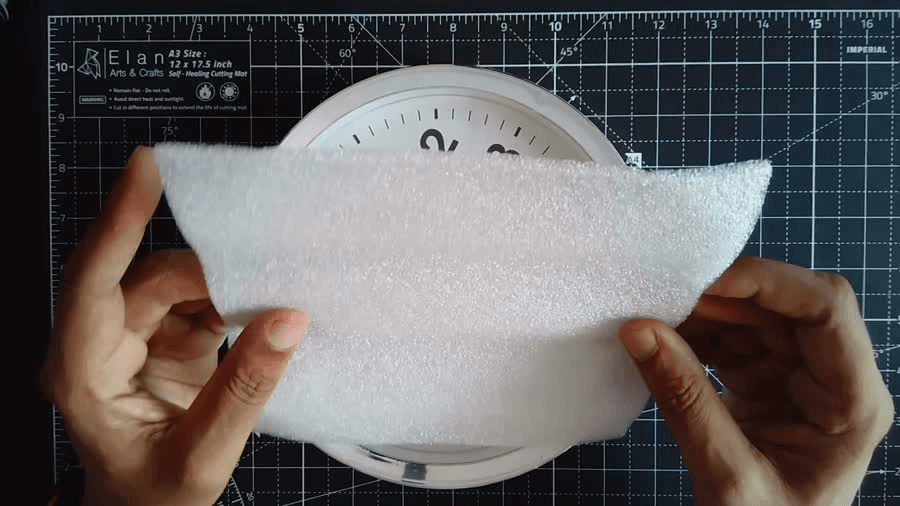
Inside, the protection is simple and cost almost nothing. A loose polythene bag over the clock, and a single moulded foam sleeve wrapped around the rim. The foam only protects the edge.


White dial, black Arabic numerals, minute ticks, a chrome-look bezel ring which is the whole visual identity of the product is that ring. It's the only body part that isn't white plastic.
The bezel is two parts

The bezel and lens separate from the body as one assembly.

And then the lens lifts out of the ring. Note how much it flexes as it comes away. A thin thermoplastic disc.

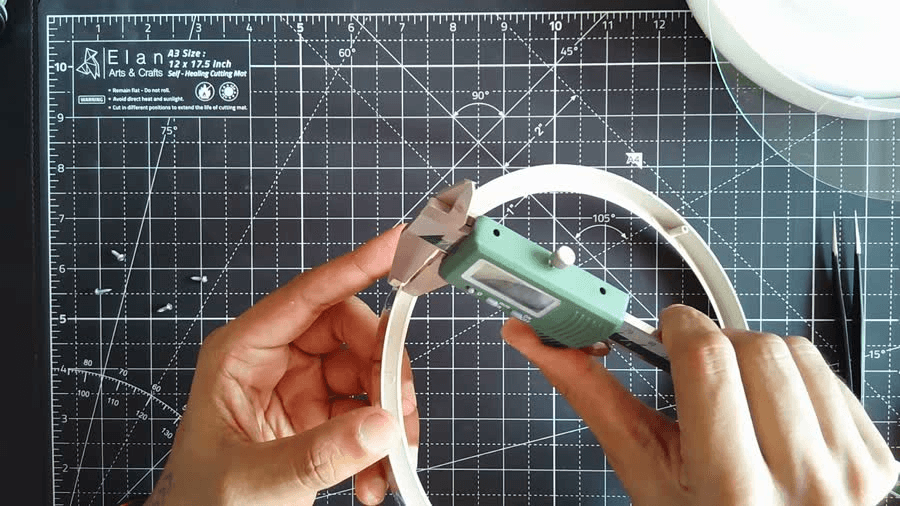
The outer face is mirror-bright; the inner face is bare cream-coloured plastic. It's a moulded plastic ring with a reflective finish applied only where the customer will see it. Inner walls have fasteners bosses for two part joins.
This is the good cost move on a decorative trim ring. A chromed plastic part after moulding goes to a separate finishing line. So they must have finished the visible part only and left everything else raw. You can see the boundary with the naked eye.



One moulding, four jobs
When you turn the clock over, you'll see the back housing is doing an unusual amount of work for a single part.


The movement of the clock is seated in the well, red setting wheel faces out for users to set time. It assembles from the back and is retained by the pocket walls.
So four things:
Structure: The dish wall provides all the clock's stiffness.
Movement restriction: A moulded pocket locates and holds the movement module, with a through-hole for the shaft.
Bezel platform: Its outer rim is the feature the bezel snaps onto.
Wall mount: The keyhole hanger is moulded directly into the back face.


Consolidating four functions into one part is a smart cost decision in this product, and it's the right one. Every function you mould in is a part you don't buy (procurement), don't stock (spares), don't handle and don't attach (assembly). The trade is tool complexity but you pay for the tool once and it amortises across every unit thereafter.
The dial, the hands, and the module inside


The bare dial is a flat disc with a single centre hole, printed on one side. This is a simple paper glued on the moulded front surface - even cheaper.


Cracked open the box. White gear train on the left, copper coil on its bobbin at the right, rotor between them. The case carries a moulded-in B6 which could be a mark common in multi-cavity moulds to trace defects.


Takeaways
Part | Process |
|---|---|
Back housing / body | Injection moulded, one-part, four functions |
Bezel ring | Injection moulded, reflective finish on the visible face only |
Lens | Flat thermoplastic disk (blanked from a sheet) |
Dial | Paper printed and glued on moulded front face |
Hands x 3 | Stamped, friction-fit |
Movement module | Bought out part |
Fasteners | Pan-head, self-tapered screws |
Cheap and badly designed are different things. Nothing in this clock is impressive on its own, but nothing in it is wasteful either. The parts do multiple jobs, the joints are all snap or press, and the one decorative surface is the one you look at. The interesting engineering is in the decision to make the back housing be the structure, the mount, the bezel land and the wall hanger simultaneously.
Finish only what gets seen. The bezel is the whole lesson in miniature: mirror-bright on the visible rim with bare, glossy finish cream plastic millimetres away.
KADIO's housing, bezel, dial, packaging is essentially to hold and present a commodity product - the clock module - that anyone can buy. This isn't a clock company's clock.