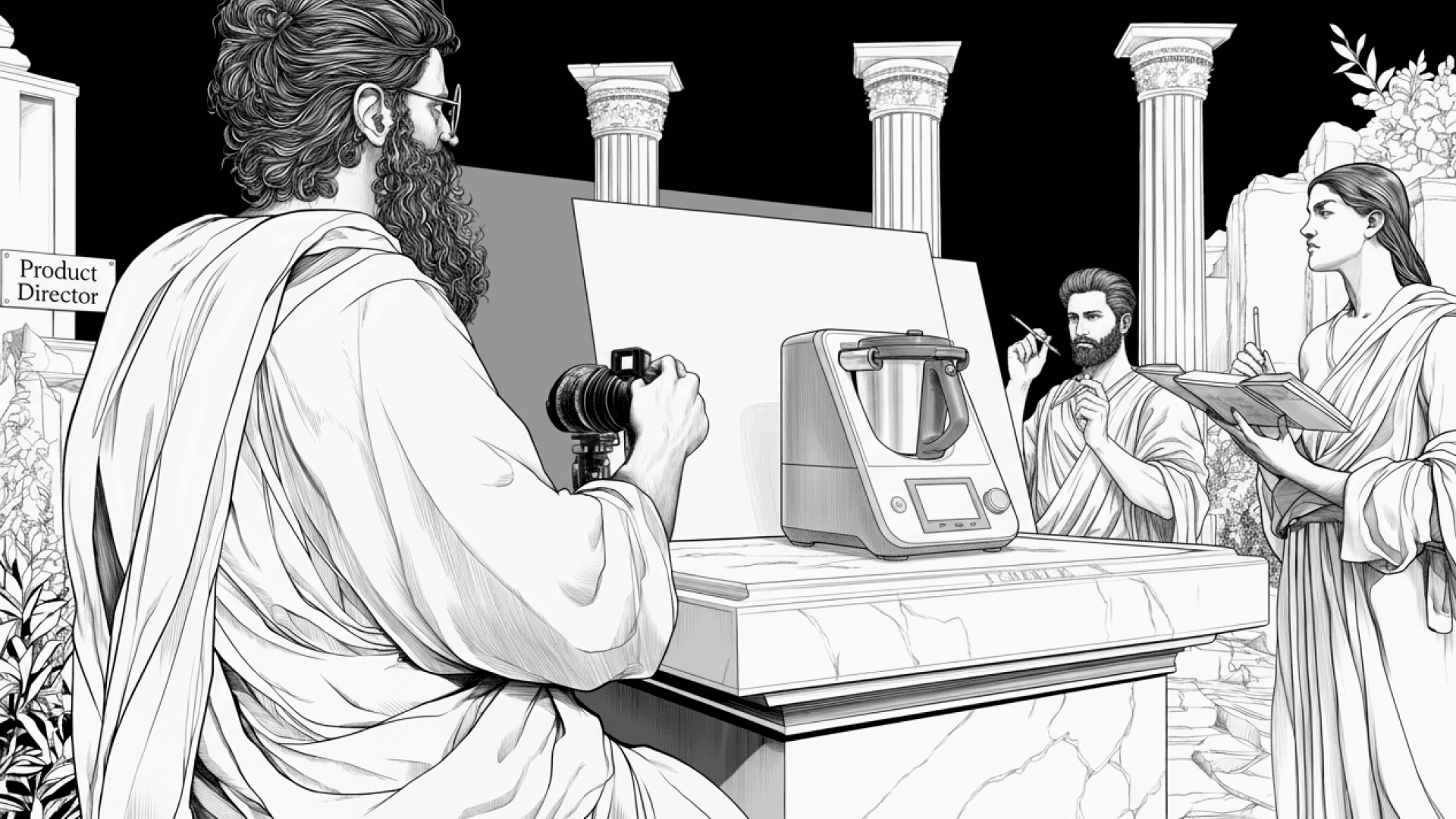
A single-brain operation
On building hardware products the way a director makes a film. What to do, what not to do, and what companies almost never do naturally.
Baby John and Theri had the same director. One made ₹40 crore, one made ₹170 crore, and the script didn't change between them. The cast did.
That's what it means to cast, not staff. When making movies, you don't take whoever is free next month. You think about who is right for this specific film, who understands the light you need, who has made something that felt like what you're trying to make.
Casting, not staffing
Now you're making an RO water purifier. Ideally, you need someone who has lived with hard water in an Indian city, had a filter choke and a membrane fail, waited for a technician who arrived and couldn't find the problem. You need a project manager who has been through a pilot run and knows what it actually costs to let schedule pressure override a quality gate three weeks before production. You need an industrial designer who understands, from touch rather than hours of ChatGPT research, why some appliances will belong in the kitchen for decades and some won't. You need a design engineer who knows what a wall thickness decision costs. Not the tooling cost but the rework in the assembly line six months later.
You need the right cast for this specific product, not the next available person in each of those roles.
The typical way in companies, if they're honest about it, is staffing. The industrial designer just came off another project. The project manager is available because something else closed. Everyone is competent and they'll hit the milestones. The product will be forgettable in exactly the way most appliances in India are forgettable, because nobody in the room had a strong enough reason to care about this specific product, in this specific category, in this specific home.
First, earn the right to cast
The first question in any film production is: who is the right cast? But before that, the director has to earn the right to cast. They have to know the material from the inside.
Teenage Engineering is a Swedish hardware design studio that makes weird, beautiful, and surprisingly serious music gear: synths, samplers, speakers, and assorted gadgets that look like toys but behave like instruments and tools for professionals. Jesper Kouthoofd founded Teenage Engineering. When he was fourteen he borrowed gear from his brother's music shop to make music: a four-track recorder, a Boss pedal, a cheap drum machine, a small Japanese synth. Those were the minimum pieces he needed to make something that sounded okay. When you look at the OP-1, you're looking at that same setup compressed into one object.
One of his designers came to him with a keyboard concept: good renders, some CAD. Jesper asked him to play it. He couldn't. That was the end of the conversation. Jesper himself has been working on a classical organ for five years. An hour or two every night with the pedals. He says he's super bad at it. But he won't finalise the product until he understands from inside the experience what makes an organ an organ. He calls this embodied understanding, where you understand what the thing does to a person before you decide what shape it should take.
For hardware in India, the equivalent is whether you've lived with an appliance that broke and couldn't be serviced, that had a part you couldn't source, that a technician visited twice and couldn't fix. If you haven't, you're designing at a distance.
This is the prerequisite before any casting question. A director who hasn't lived inside the story has no business choosing who tells it.
Every film has one director
Every film has one director. It has nothing to do with directors being possessive (many are though), but because a film is a point of view, and a point of view can't be shared.
At Teenage Engineering, one person makes the design calls. There's a team of eight or ten who assist, but the calls are Jesper's. Not about just aesthetics. It's politics, culture, what the object says when you walk past it, how it feels when you put it down. You can't run that through a group and expect it to hold a point of view.
Groups produce consensus positions. A consensus position is the thing everyone could live with, which is different from the thing anyone believed in. It's the safest bet. When it's one person's call, that one person holds the point of view and defends it at every decision. Remove that and every department starts making a slightly different product. Eventually you have a product that's not disliked by anyone.
This is the hardest part to protect inside a growing company. Early on, when the team is four people in a room, the point of view is in the air. Everyone is close enough to the source that they can feel it. As the team grows, the distance between decisions and the person who should be making them increases. The point of view starts to diffuse. It happens over dozens of small decisions where the wrong person answered a question that should have gone further up the chain.
Who ruins it quietly
Every film production also has people who didn't get cast but ended up on set anyway. They ruin films quietly. The threat to the single brain isn't usually from above. It's the producer who keeps asking whether a scene is commercially viable while the director is trying to figure out whether it's true. Not a bad person. Just doing the wrong job in the wrong room.
In a hardware company, that person is easier to spot by behaviour than by title. When a product decision is being made, notice the first question in the room. If it's about the BOM before anyone has asked whether the decision is right for the product, you've found them. The BOM question matters, and it does, but it's the second question. When it becomes the first, the room has stopped making a product and started managing a cost centre. Good ideas get quietly scoped down, sent for another round of validation, shelved because the comfortable option has precedent and nobody's job is at risk if you pick it. The damage is invisible in any single meeting and completely visible in the product that ships eighteen months later.
How to actually cast
Jesper's hiring process is to take a chance fast and see. He'll hire someone because it's genuinely fun to have a beer with them and they tell good stories. Not as the only input, but as a real one.
A man knocks on the garage door one day and says he loves their products. They invite him in for coffee, he starts in marketing and is, in Jesper's telling, kind of useless there, moves to support, and twelve years later he's head of development and one of Jesper's closest friends. No interview would have produced that. It happened because someone opened the door.
Passion is easy to claim and impossible to fake over the full length of a project. The person who actually has it is still thinking about the problem on the drive home, still the one who noticed the parting line on the A-surface before anyone else in the room. They're the one who pushed back on the wall thickness call at 11pm when everyone else had already moved on. The person performing it has moved on before tooling closes. You can't tell the difference at the start of a project. You can always tell by the end.
Jesper says he designs for himself, and if he wouldn't buy it, he'd be depressed. His years in advertising he describes as twenty years of not doing that. It means there's at least one person in the process who can't be fooled by the product passing a gate.
What happens without any of this
A lot of hardware products are made without any of this and the result is predictable. When you haven't lived through the build journey, every line on the spec sheet looks the same from the outside. Features become variables that are adjustable, removable, or replaceable at low consequence. So you remove the wrong one, or add something in its place because it looks equivalent or because it saves COGS. The product moves forward and something leaves with it that's hard to name until you're holding the finished unit six months later wondering why it feels slightly off. It ships, gets replaced in a few years, adds one more option to the list.
The experiment
Here's the experiment I keep turning over in my head for the next product.
What if we ran it like a film production? Start with the brief the way a director starts with a script without a PRD, without a feature list, but a clear point of view about what this product is for, who it's for, and what it should feel like to live with. Then cast every role against that brief. Not who's available. Who is right for this product, at this stage, given what we're trying to make.
It would mean finding an industrial designer who has lived with the problem, someone whose kitchen counter has had this object on it, who knows what breaks and what annoys and what quietly delights over two years of daily use. It would mean a project manager who treats the brief as something to protect rather than a schedule to hit. It would mean knowing who the director is, one person holding the point of view across every decision from the first sketch to the first production unit, and giving them the actual authority that role requires, not just the title.
It would mean asking, at every decision point, one question: would I want this in my home? Whether I'd actually want it. On the Native RO I kept coming back to this. The kitchen counter mattered more than the features and specs. Whether I'd want this object next to the things I chose for myself. The moment the answer softens to "it's fine," something has already gone wrong somewhere behind me.
I don't know what that experiment looks like inside a company with timelines, headcount constraints, and a BOM that has to hit a number. But the question isn't about company structure. It's about whether the people in the room are there because they were cast for this product, or because they were available when the project started. The challenge is standing through this decision because staffing is faster and easier to defend. Casting takes conviction and occasionally looks like stubbornness from the outside.
Jesper has been learning organ pedals at midnight for five years, still bad at it, still going. He's not building the product yet. He's making sure he has the right to build it. That when it ships, at least one person in the world made it by understanding from the inside what it was asking of the person who would sit at it.
That's the cast you're looking for. For every role. On every product.