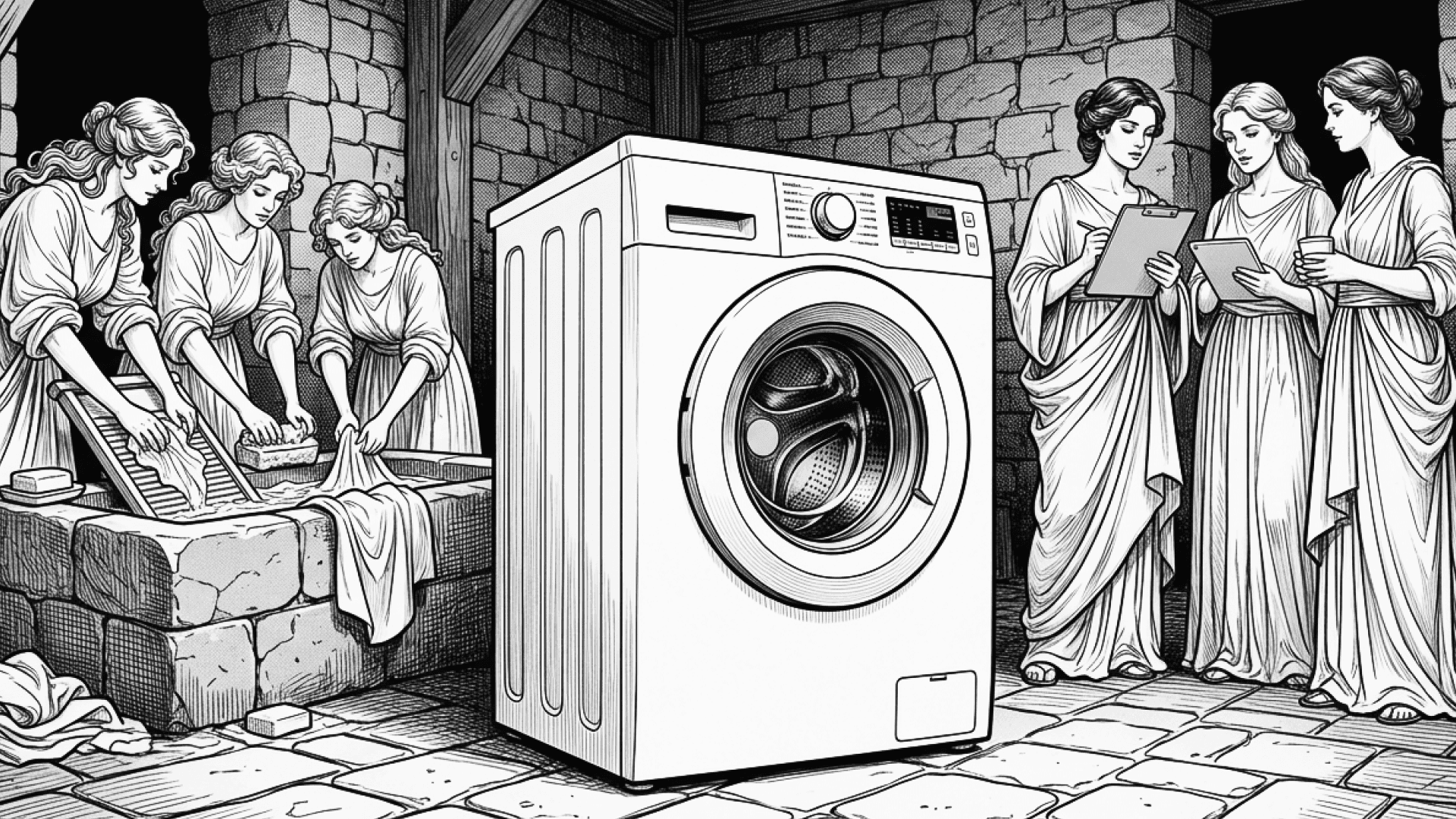
Washing machine: The hope purchase
Why the most liberating appliance in history is also the most over-designed one
I did a long conversation with Kedar Nimkar about designing consumer hardware for India, about what premium means, about how we think about products at Native, about what industrial design schools are getting wrong. It covered a lot of ground.

Kedar opened with a rapid-fire round. Fast questions, fast answers and it was fun. Some of those answers I gave in under five seconds and they've been sitting with me since. Particularly one about washing machines. This post is the extended version of what I was actually trying to say.
The question was: one appliance Indians buy more for hope than utility? My answer was Washing machine. You know… the washing machine is actually a hope purchase. Let me explain.
It was years ago when I read that one of greatest invention of the industrial revolution was the washing machine because it was instrumental in changing the roles of women in the society dramatically. In the 90s, women would spend about 50-60 hours a week on household chores. By 1975, after washing machines had achieved mass penetration in Western households, that number was 18 hours. A single load of laundry went from four hours to forty-one minutes. What did women do with those recovered hours? They entered the workforce. Married women's employment went from five percent in 1900 to over fifty percent by 1980 in the US. Women who had previously worked as laundresses found better-paying jobs. Women who had been financially dependent had, for the first time, the option to leave.
In India, as of 2016, roughly eleven percent of households owned a washing machine. Eighty-nine percent were still hand-washing. (This was simple Google, so please check facts.)
The liberation story that played out in the West over the last century is, for most Indian women, still ahead of them. The recovered hours is exactly why the people buying washing machines aren't buying them for just laundry. They're buying them for what that eleven percent represents.
In the same rapid-fire round where I said washing machine for hope, I also said washing machine as the most over-designed consumer product in Indian homes. Closely followed by the microwave.
I gave both answers and didn't connect them out loud. That's the thing I've been wanting to fix hence this post.
Because the machine that carries this much weight of hope, that has this much documented potential to free up hours, to reduce the physical toll of household labor that falls almost entirely on women, to signal that a family has crossed some economic threshold. Unfortunately, it's the same machine we've buried under mode buttons, AI wash cycles, steam programs, quick wash overrides, tub clean settings, and a cycle selector that goes twelve positions deep. I have pressed the AI wash cycle button at a friend's place a few years ago and the clothes came out the same - clean.
I have three washing machines' worth of features I have never used. The dial on mine has maybe two positions I actually turn to. The rest exists for the spec sheet, or for the marketing department who thought more features justified a higher price point, or for the industrial designer who has never watched anyone actually do laundry. None of it is for the person using the machine at seven in the morning, late, throwing in yesterday's clothes, pressing the same button they pressed last time.
Another thing I tried to articulate in the interview and didn't fully get to. The difference between designing for steps and designing for moments.
The step version of using a washing machine: open lid, sort clothes by fabric type, select temperature, select cycle, select spin speed, add detergent in the correct compartment, close lid, press start. Only the sales person at a store uses it like that.
The moment version: it's Tuesday morning. You're already running late. You grab yesterday's clothes from the chair, throw them in, pour powder in vaguely the right direction, press the button you pressed last time, and leave.
That is the actual use case for ninety percent of wash cycles in Indian households. The machine's job, in that moment, is to receive clothes and return them clean. Everything else is friction.
You can read the full post here.
The ceiling fan is my favourite consumer hardware product, and I mean it without irony.
It has, in my view, completed the design problem. It has minimum viable interface for maximum daily use with one switch, one regulator, and five speeds. Done. The mechanical solution is also quite simple with a motor, the blade pitch, and simple RPM calculations for Indian room sizes. The user never thinks about it. It installs once and runs for 10-15 years or more in homes with brownouts, dust, children pulling at the regulator, and no maintenance beyond the occasional wipe. I love the product! It's extraordinarily well-designed. Now, compare it to a smart fan with an app. Someone at the company must have thought that connectivity was a feature. I mean, the regular was already the app! The regulator IS better than the app.
We have smart fans at our home because our landlord installed them when we moved in. None of us downloaded it and the fan runs fine.
There is one more argument I didn't get to in the interview, and it's the one I think about most when we're building products at Native.
In digital, when something ships wrong, you patch it with another release. I spent years in that world before hardware. It makes you fast because being fast is cheap; the cost of a mistake is one more deployment. The industry rewarded that speed, and most of us who came from the software world internalised it.
Hardware doesn't work like that.
A washing machine in someone's home is in their home for eight to ten years. There is no over-the-air update. You cannot go house to house replacing panels. The decision made in a CAD file is what a decade of daily use feels like for a real person in a real home.
This is why hardware forces a different relationship with time. You have to sit with one component for hours and think through every person who will ever interact with that surface, because you cannot go back. The thing you ship is the thing they live with.
I leave all founders, software to hardware shifting folks to leave with this thought.
There was another conversation in the same podcast on what premium actually means across different products in different Indias (plurality) who use them in different contexts. That argument is in the second post. Read it here.